2015-03-16

Second Warmest February

Tom Yulsman's blog at Discover tells us that NASA has released figures showing that this February and this past winter are the second warmest on record. He also has a great animated graphic of the disparity between a lot of people's perceptions and the reality of global warming in light of recent weather.

Yulsman combines NASA images of temperature anomaly -- departure of monthly average temperature from the long-term mean for the same month -- for the three months of the winter that many in the US just suffered through. His post also has a great explanation of just what the situation was that made the eastern part of the U.S. experience such cold and wintry weather.

Predictably, quite a few people who experienced that cold are yet again calling into question whether there can be any such thing as global warming. They feel cold. How can the earth be warming?

This is a lot like a person going into a coal mine on a bright and sunny day, turning off the lights, and then claiming that the sun has gone out.  "I can't see the sun, so I guess it stopped shining." Or, "I feel cold, so I guess global warming is a myth".

But the whole idea of global warming is that, though it may be unseasonably cold in some places, it's a lot warmer in other places, so that the average temperature of the earth is warmer compared to earlier periods in history.  Look carefully at the animation above. During the period when the eastern part of the U.S. was so much colder than normal, what was happening over all of Siberia and the northwestern half of North America? How much of the southern hemisphere had warmer temperatures than normal?

2015-03-14

Fair to Partly Whalish

A Reuters news story ("World carbon emissions stall after almost 40 years of gains: IEA") reports that the International Energy Agency has finished their tabulating and concluded that the human race released 32.3 billion metric tons of carbon dioxide into the atmosphere in 2014, approximately the same amount as in 2013. In the same year, the global economy grew by three percent. So we know that we can have economic growth without worsening the emissions problem.

So everything's cool now, right?  We can stop worrying about global warming?

32.3 billion metric tons is 71.2 trillion pounds. That's about the same as 6 billion African elephants or 187 million blue whales. or 98 thousand copies of the Empire State Building. It's the same weight as 376 copies of the aircraft carrier USS Enterprise, fully loaded.

We do not notice the carbon dioxide that we add to the atmosphere, because it's invisible and odorless. But, if we could somehow put 187 million blue whales into the air each year and keep them aloft and visible, you'd pretty soon be able to see the problem. That's about four whales per square mile, distributed over the surface of the earth.

After a few years, the weather forecasters would be talking about "fair to partly whalish".

So no, we can't stop worrying about global warming. We need a lot fewer whale equivalents being injected into the atmosphere.

2015-03-13

I'm Happy to Report that I'm Happy!

ScienceDaily has an article today on happiness and politics.

The article summarizes a research report (Wojcik, et al., 2015) that appeared in Science recently. A group of five psychologists have taken another look at the previously reported result that political conservatives are happier than liberals. That earlier research was based on what the research subjects reported. On average, conservatives reported being happier than liberals.

This new research ignores what people claim about their own happiness and instead focuses on observable behaviors that are linked to happiness. The abstract from the Science article has this quote: "Relative to conservatives, liberals more frequently used positive emotional language in their speech and smiled more intensely and genuinely in photographs."

So there you have it.  Conservatives claim to be happier. Liberals actually are happier.

This result actually tallies well with much of the essential message of Jesus. Happy ("blessed") are the meek who don't force their ways upon others, but instead appeal for agreement. Happy are those who give mercy instead of insisting on everybody (that is, everybody else) getting the punishments that they so richly deserve. Happy are those who try to achieve peace.

Happiness comes through following the two most important laws: Love the Lord your God, and love your neighbor as yourself.

Just in case you've heard and repeated that second one so many times that it has lost its meaning, go back and look at it afresh: In whatever way you would like to treat yourself, treat everybody else on the planet in the same way. Get rid of selfishness. Don't put yourself first. Put others ahead of you. Give liberally to others who need it.

Live that way and you'll be happier.


References:

University of California - Irvine. (2015, March 12). Political liberals display greater happiness, study shows. ScienceDaily. Retrieved from www.sciencedaily.com/releases/2015/03/150312142909.htm

Wojcik, S.P., Hovasapian, A., Graham, J., Moty, M., & Ditto, P.H. (2015). Conservatives report, but liberals display, greater happiness. Science, 347(627) 143-1246, doi: 10.1126/science.1260817

2015-03-10

Arctic Surprise

An article in Discover reports that early March sea ice extent in the arctic has collapsed, likely producing a new record low.

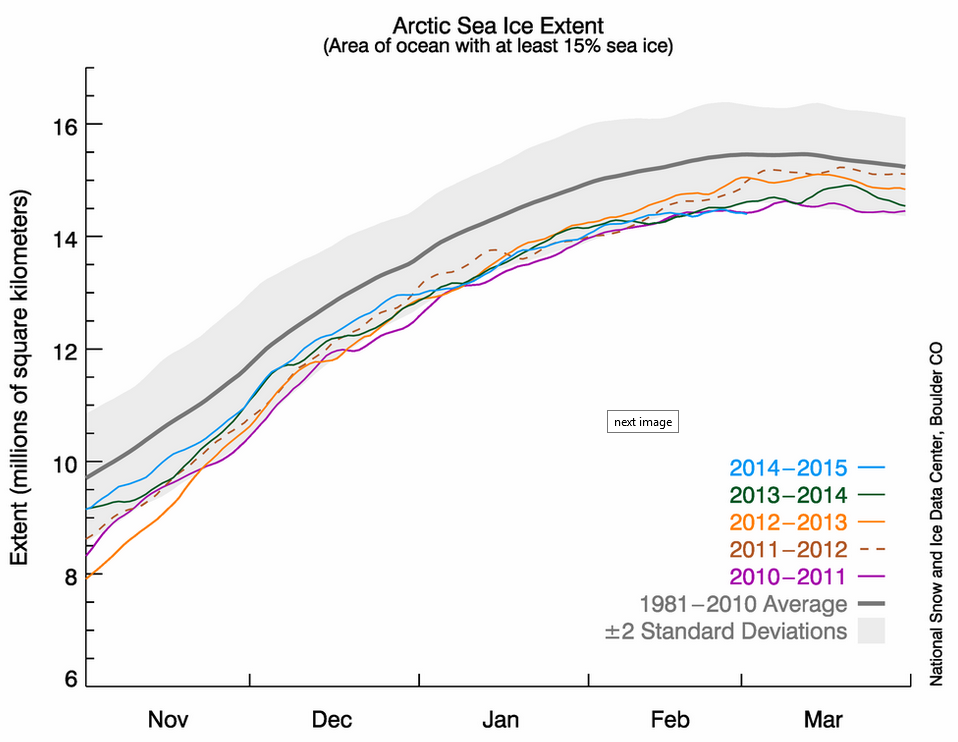
The article highlights a new plot from the National Sea Ice Data Center, contrasting the current year's sea ice extent (the blue line) with the thirty-year average (heavy black line) and the range of values (grey area) between the +/- 2 standard deviation bounds. 


A word of explanation to those who don't think of statistics as their native language:  Anything outside the two-standard-deviation bounds is something that any scientist will regard as surprising. In practice, we use much more technical metrics, involving p-values, significance levels, statistical power, and other arcana. But a very good, quick and dirty approximation is that anything more than two standard deviations from its average is surprising, "statistically significant". It's in the realm of things that are unlikely to have occurred by chance, so we generally take these occurrences as probably indicating that something systematic is going on.

In this case, the "something systematic" is climate change. As with all individual weather phenomena, this observation is not ironclad proof of global warming.

But this situation has clear physics: Ice reflects daytime solar energy to space and radiates night-time heat from the sea, resulting in net cooling. The less ice, the less cooling. The less cooling, the less ice. A positive feedback can result, contributing to significant warming of the polar regions, melting of glaciers, and thawing of permafrost, resulting in release of methane, a much more potent greenhouse gas than carbon dioxide -- all of which results in more warming.

So it's especially galling that the other climate news story today (see this version from UPI) says that Florida officials, under Republican Governor Rick Scott, have clearly and unambiguously passed the word that Department of Environmental Protection employees are forbidden to use such terms as "climate change", "global warming", or "sustainability". It is telling that this policy was published only by word of mouth. Whoever gave this order did not have the guts to put it in writing. But a number of different DEP employees tell the exact same story, so I tend to provisionally accept it.

When the facts clearly tell one story but political or business or religious leaders dictate that nobody actually mention any of the facts, one conclusion leaps quickly to mind: Somebody has something to hide. Let's bring that out into the light of day and look at it.

2015-03-06

And Another News Item about Climate Change

Another ScienceDaily article reports that tides have changed over the past century, in many cases rising more than a millimeter per year, at a rate that is comparable to the sea level rise over the same period. The researchers (Mawdsley, Haigh, and Wells, 2015) concluded that the primary cause is climate change.


Reference:

Mawdsley. R.J., Haigh, I.D., & Wells, N.C. (015). Global secular changes in different tidal high water, low water and range levels. Earth's Future, doi: 10.1002/2014EF000282

Yet More Evidence of Climate Change

An article at ScienceDaily summarizes a new research report by Lindsay and Schweiger (2015) showing that arctic sea ice is vanishing at an alarming rate. Between 1975 and 2012, what ice was present in the arctic thinned by a remarkable 65 percent. This report really ought to put to rest any doubts about whether global climate change is happening.

The study was based on U.S. Navy submarine observations from the Cold War era, as well as later aircraft and satellite measurements.  I have not yet read the journal article, so I cannot comment about whether the authors adequately controlled for disparities in sensor characteristics over that fairly long time span. I assume that they know what they're doing.

Of course, that the arctic is losing ice cover is not news. This is just new, experimental confirmation of what the National Snow and Ice Data Center has been saying consistently for years. Here's their plot (NSIDC, 2015a) of the past five years of sea ice extent for the colder months of the year. All five years' figures are significantly lower than the thirty-year average, indicating that the sea ice is declining.


And here's the NSIDC (2015b) time series plot of sea ice extent for the month of February over a thirty year period, again showing quite clearly that the arctic is losing ice.


You may wonder why this is important. That would be because of the unique and wonderful properties of water. When it's liquid, it soaks up a lot of solar radiation, warming the water and the air above it. But, when it's solid snow or ice, it reflects nearly all of the solar radiation that hits it. So we get a positive feedback effect: A little warming causes a little loss of ice, which causes more warming, which causes more ice loss, and so on. The arctic and antarctic regions thus lead the way in the global climate change that is now very firmly in progress.


References:

Lindsay, R., & Schweiger, A. (2015). Arctic sea ice thickness loss determined using subsurface, aircraft, and satellite observations. The Cryosphere, 9(1) 269-283, doi:10.5194/tc-9-269-2015

National Sea Ice Data Center. (2015a). Arctic sea ice extent [Image]. Retrieved March 6, 2015, from http://nsidc.org/arcticseaicenews/files/2015/03/Figure2-350x280.png

National Sea Ice Data Center. (2015b). Average monthly arctic sea ice extent, February 1979 - 2015 [Image]. Retrieved March 6, 2015, from http://nsidc.org/arcticseaicenews/files/2015/03/Figure3-350x270.png

2015-03-05

Who is a Christian? [Part 4]

Tom, a friend of mine, commented about my last post, saying that he apparently doesn't know any real Christians. I think that's a bit strong, but I take his point.

Tom was reacting to what Jesus had said, that people would know that we're his disciples because of the love we demonstrate for each other, as well as what the apostle Paul wrote about doing good things for others, especially for those of the household of faith. I had made the point that, if we did this, there would be enough evidence to convict us of being Christian.

I don't really believe that our all too frequent failure to be recognizable in that way makes us fail to be real Christians. But I do think that real Christians tend to have at least a subliminal recognition that, when life isn't like that, Something Is Very Wrong!.

Sometimes, it seems like the extent of the Christian's life is going to church on Sunday morning, standing in a darkened auditorium, staring at the "praise and worship team" who are conducting a concert on a brightly lit stage, not singing because the music is too loud and it's pitched all wrong for anybody but the lead singer, shaking hands with each other during the mandated fellowship minute, and polishing off the morning by listening to a motivational speaker. 

Even when it's a wonderful motivational speaker, that's not the sort of life that Jesus said would make everybody recognize us as his disciples.

I think we all want more than that.

This is the place where you're expecting me to tell you how to solve that problem. Sorry, my little bottle of Wisdom of Solomon seems to have run dry. I don't have the answers.

What I do know is that busy modern life in large cities (where we tend not to live anywhere close to the people we spend time with during work hours) militates against most of us having fulfilling, close relationships to others, so that the kind of deep family formation we should be experiencing is very hard to do.

I'm open to suggestions from others who feel the same way about this.

Anybody?

Who is a Christian? [Part 3]

It used to be common for preachers to ask, "If being Christian were illegal, would there be enough evidence to convict you?"  What, in the end, would clearly identify anybody as Christian?

Conclusions so far in this series:

  • Being a lover of God and of one's neighbor as oneself is not a sufficient condition to define whether a person is a Christian. It's necessary, but not sufficient.
  • We can't assume that those who call themselves Christian are, in fact, Christian. Christian identity is not particularly relevant.
Brian McLaren has a very good piece on the "God's Politics" blog at Sojourners (http://sojo.net/blogs/2015/03/04/7-ways-live-faithful-life), titled "7 Ways to Live a Faithful Life". He enumerates seven behaviors that really ought to follow directly from a person's faith as a Christian. Please go read it. It's important.

But it still doesn't answer the question.

It falls under point 1 above. Based on other things Brian has written, I'm sure he'd be the first to agree that these seven behaviors would probably also follow from a person's faith as a Buddhist, Jew, or Muslim. If you're a Christian, you're likely doing these things. But others do them as well.

I think, though, that we might get very close to an answer if we look at these words from Jesus:

"A new command I give you: Love one another. As I have loved you, so you must love one another. By this all men will know that you are my disciples, if you love one another" (John 13:34-35, NIV).

Recall that he had already noted two important commandments: Love God and love your neighbor as yourself. This one sounds a lot like the second commandment, but Jesus says it's new. How?

Perhaps the explanation can be seen in what Paul wrote: "Let us not become weary in doing good, for at the proper time we will reap a harvest if we do not give up. Therefore, as we have opportunity, let us do good to all people, especially to those who belong to the family of believers" (Galatians 6:9-10).

There's something special about doing good for other Christians.

I think the answer is in Paul's use of the word "family" (or "household" in other translations). Being a Christian, following God in what McLaren calls "the way of Christ", involves recognizing a special kinship with other believers.

But isn't that just what point 2 above said was not sufficient?  Not really. A great many people identify themselves as Christian but feel no special kinship with other Christians. They identify without investing. The key is to invest, without regard to identity, but because of whom we follow. We inevitably develop identity from that investment, but the key is the investment: Invest your wealth, your energy, your life in actively loving all of the others of the family of believers -- or, at least, all of them that you come in contact with.

This doesn't mean that you shake hands during the sixty seconds of programmed fellowship in your Sunday morning church service. It means to share your life with other believers, acknowledging that you're part of a family, and acting accordingly.

Do that, and anybody could convict you of being a Christian.

2015-03-03

Who is a Christian? [Part 2]

Earlier today, I concluded that, if you want to find a Christian, you should start your search with people who follow Christ's way of loving God and loving others. Is that a sufficient condition?

That seems unlikely.

By that definition, millions of Muslims would qualify as Christians. Most Christians would not accept that idea, and most Muslims wouldn't either. But any Muslim who follows the precepts of the Quran loves God and treats other people pretty much the way Jesus asked. The essence of Matthew 22:37-38 can be found in the Quran -- in the second Surah, in fact. The extremists who engage in terrorist acts are about as Muslim as the Ku Klux Klan is Christian. But that's a thought for another day.  What I want to address today is the question of just what it is that makes a person Christian.

I would not think that we'd need to examine the idea that a person can be a Christian by virtue of being born Christian. Such an idea is foreign to the concept of repenting and deciding to follow the way of Christ. Yet many people's Christianity appears to be little more than an accident of birth. It's not whom they elect to follow, but what group defines their identity.

Here, I think, we can find the crux of several problems: Identity. People who claim to be Christian are not necessarily describing a religious faith, but rather an identity. It's sort of like when a misguided young man tells you what gang he belongs to. He may or may not subscribe to all of the gang's ethos, but he's part of the gang -- it's his identity.

It sounds disparaging to liken a religious group to a gang, but religious groups have often made violent gangs look like Sunday School.

One of the most dangerous things a Christian can do is to allow his or her identity as a Christian to become a matter of identification with a group rather than identification as a follower of the way of Christ. Such has been the root of a great many conflicts and outright wars -- between Christians and those of other faiths, as well as between different sects of Christian.

Most of us probably don't think we're like that, but how many politicians have made sure to telegraph their purported Christianity to the Christian voters they hope to represent? How many voters have voted their religion instead of their political philosophy?

Jesus said, “Not everyone who says to me, 'Lord, Lord,' will enter the kingdom of heaven, but only he who does the will of my Father who is in heaven. Many will say to me on that day, 'Lord, Lord, did we not prophesy in your name, and in your name drive out demons and perform many miracles?' Then I will tell them plainly, 'I never knew you. Away from me, you evildoers!'" (Matt. 7:21-23, NIV). 

So let's just reject the idea that a person is a Christian just because he's a member of the Christian identity group, whether born into it or joined later.

There's something more than that.


Who is a Christian? [Part 1]

A Reuters news story out of Olathe, KS, reports on a hearing to decide whether Frazier Glenn Cross Jr. should be tried for murder. Nearly a year ago, witnesses stated, Cross shot and killed three people outside Jewish centers. Enough evidence has been presented to conclude that Cross is an antisemite who took these actions because he hates Jews.

To all those folks who have criticized President Obama for his comment that Muslims are not the only terrorists -- and that some terrorists claim to be Christians -- I'd just like to point out that this is only one of many cases that prove him right. According to the article, law enforcement already knew that Cross had been a senior member of the Ku Klux Klan, an organization that purports to be Christian. So it's evident that some who call themselves Christian are terrorists.

Of course, that's just one incident. Are there more?

The Southern Poverty Law Center (SPLC) monitors hate groups and fights extremism. Their Hate Map depicts the distribution of hate groups in the United States. By their count, at this date, there are 939 distinct, active hate groups operating in this country. The SPLC's legal actions have succeeded in shutting down some hate groups, but hate is a hydra. Shut down one group, and more pop up to replace it.

Not convinced? Check out the SPLC document "Terror From the Right: Plots, Conspiracies and Racist Rampages Since Oklahoma City". It gives a detailed history of dozens of terrorist incidents in the U.S., over a ten-year period. Many of those acts were committed by people who claim to be Christian.

By what stretch of the imagination can any of these perpetrators of violence claim to be Christian? Christians are followers of Christ. Just before he physically left this planet, Jesus instructed his disciples to go into all the world, "teaching them to obey everything I have commanded you" (Matt 28:20, NIV). What did he command? "Love the Lord your God with all your heart and with all your soul and with all your mind" and "Love your neighbor as yourself" (Matt 22:37-38). He made it clear, in the parable of the good Samaritan, that everybody is our neighbor. Christians follow this path.

In what twisted universe does violent rage against innocents constitute loving God and loving others?

But the important question is not who is a Christian, but rather what we Christians are going to do about hate groups.  Maybe we should hate them?

Uh, that's kind of a contradiction, right?

No, the way to fight hate is to love.  My wife, Kathleen, has recently written a story about one man who did exactly that. You can find the story on the website of "The Faith and Peace Project". She chronicles the life and ministry of an English pastor who gave himself to the establishment of peace in Ireland and Northern Ireland. He is but one of many who put their lives on the line to help that troubled island find healing. The "Troubles" in Ireland are now in remission (though certainly not without the potential for flare-ups). Kathleen has personally witnessed former IRA soldiers worshiping in a protestant church that counts, among its members, a large contingent of former Catholics.

Who is a Christian?  If you're looking for one, start with somebody who knows how to love.